
Archive 2012
Jury LFF 2014
Born in December 1980 in Beirut during the civil war, Ibrahim Maalouf learns to play the trumpet with his father Nassim Maalouf who teaches him classical western music and traditional Arab music. His father, who has notably played with Fairuz, invented in the sixties a unique trumpet that enables to play Arab music
After attending the CNSM in Paris, Ibrahim wins many international contests of classical music (Hungary, Finland, France, and USA) and becomes a classical trumpet player. He plays in numerous festivals in France and internationally (Festival Jeune Solistes d’Antibes, Festival d’Automne des Jeunes Interprètes, Festival de Musique Romantique de Saint Petersburg, International Trumpet Guild Conferences in Dallas and New York).
His artistic and cultural distinctiveness led him to meet singers like Mathieu Chédid, Vincent Delerm, Georges Moustaki, Vanessa Paradis, Jeanne Cherhal, Thomas Fersen, Arthur H, Amadou and Mariam, Lhasa de Sela, Salif Keita and many others. A few years later, Sting invites him to participate in of his singles of his album “If on a winter’s night”, released in 2009 at Deutsche Grammophon.
His two first albums were ranked on top in the jazz in France and enabled him to have a real name and a loyal public. Even though his trumpet resonates as a true promise of escape, the young man never stops playing classical music
Invited to the Printemps de Bourges, the Montreux Jazz Festival, the Montreal Jazz Festival, the New York Jazz Festival, Jazz à la Villette, the Nice Jazz Festival, the London Jazz Festival and many other prestigious jazz festivals, Ibrahim is undeniably one of the most seen artists of the French musical scene and one of the few to play jazz with tendency to contemporary music, to be influenced by all kinds of music of the world and to lead a successful classical career.
Ibrahim received lately the title of “Young Artist for Intercultural Dialogue between Arab and Western Worlds” from the UNESCO
Ibrahim Maalouf

Born in Paris in 1956, Christophe Donner is a director and a writer who published around 50 books. He grew up in the Parisian suburbs and started his career in cinema as an actor without any degree, then as an editor. Next, he directed a few short and medium-length movies. His first novel, “Petit Joseph” is adapted to the screen by Jean-Michel Barjol in 1982, for which he writes the adaptation and the dialogues, and plays the role of Daniel, the interned psychiatric uncle.
After “M’en fous la mort” in 1985, he publishes “L’Esprit de vengeance » (1992), « l’Empire de la morale » (2001), where he talks about “incestuous links” between psychoanalysis and communism and is awarded the “Prix de Flore” for this novel. He talks again about revolution in “Un roi sans lendemain” (2007).
He was also a great reporter for the magazine “Globe Hebdo”, which led him to travel to the USA, Mexico, Russia and Africa.
After holding a literary chronic in “Le Monde 2” for five years, the magazine’s new formula allows him to cover all current cultural events.
He comes to Beirut frequently where his family-in-law resides. He mentioned it in his latest book “Vivre encore un peu” (2011)
Christophe Donner

Suzanne Khardalian is a film director of Lebanese Armenian origin who presently lives in Stockholm, Sweden. She studied journalism in Beirut and Paris and worked as a journalist in Paris until 1985 when she started to work on films. She also holds a Masters Degree in International Law and Diplomacy from the Fletcher School at Tufts University and contributes articles to various journals. She has directed more than 20 films that have been shown both in Europe and the United States.
A number of her films deal with Armenian issues.
Suzanne Khardalian is the director and producer of the riveting new film “Grandma’s Tattoos” that lifts the veil of thousands of forgotten women – survivors of the Armenian Genocide. The film was produced in Dec 2011.
The theme of genocide is a recurring one in her works. In 1988, Khardalian directed “Back to Ararat,” the first feature-length documentary about the Armenian Genocide ever made. It won the Guldbuggen Award for Best Swedish Film in 1988, the equivalent of the Oscars. In 2005, her film “I Hate Dogs – The Last Survivor” met critical acclaim for its stark depiction of a Garbis, a 99-year-old Armenian Genocide survivor whose lifelong hatred for dogs has its roots in the atrocities he witnessed in 1915.
Khardalian has also dealt with the war in the Middle East and has several films covering the Palestinian question.
Two films were made on the war Nagorno Karabagh. In 2002, “Where Lies my Victory”, tells about the fate of the war heroes, both men and women, depicting their post-war lives. While In 1989, she made the first international documentary on the liberation war of Nagorno Karabagh, when the movement was in its embryo. The film had the title “A Secret War in the Soviet Union”.
She has filmed in Europe, India, South East Asia, dealing with themes such as globalization and the third world, immigration and Europe, xenophobia.
All of Khardalian’s films have been aired on European channels, made to numerous film festivals.
(2012)
Suzanne Khardalian

Winners LFF 2014
Downloads LFF 2014
Best Fiction
Special Mention / Fiction
Best Documentary
Best First Film
Best Experimental film
‘’Sporting Club’’, Zalfa Seurat
‘’Siham’’, Cyril Aris
‘’Scheherazade’s diary’’, Zeina Daccache
ex-aequo ‘’The wall’’, Odette Makhlouf // ‘’Mondial 2010’’, Roy Dib
‘’Incarnation of a bird from an oil painting’’, Roy Samaha & Omar Fakhoury
Awards for film in the Official Selection

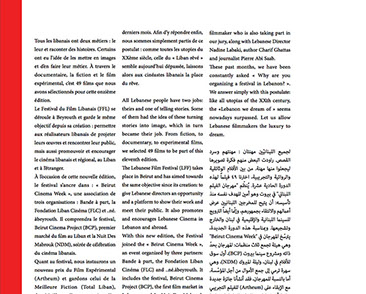
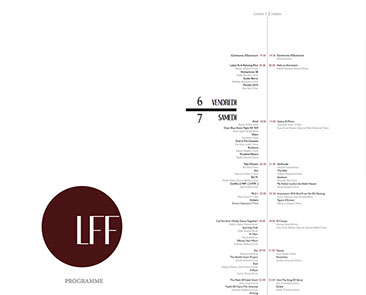

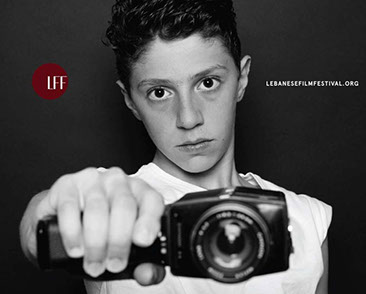
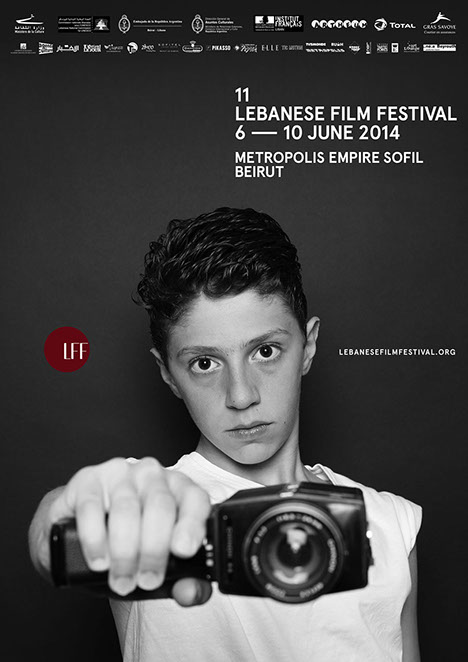
Posters LFF 2014
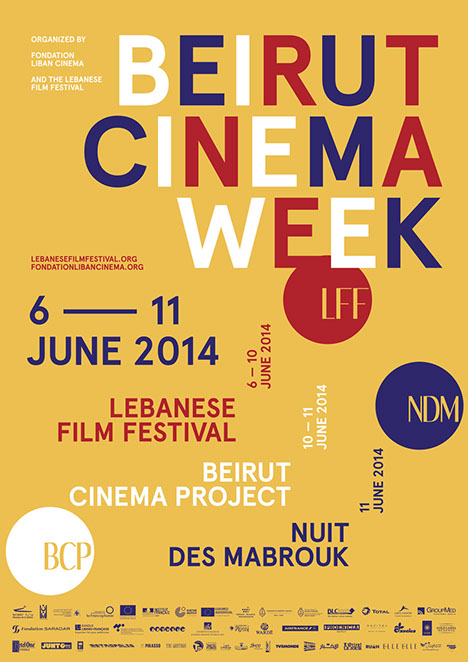
Trailers LFF 2014
LFF Official 2014
Trailer 2014
Photos LFF 2014
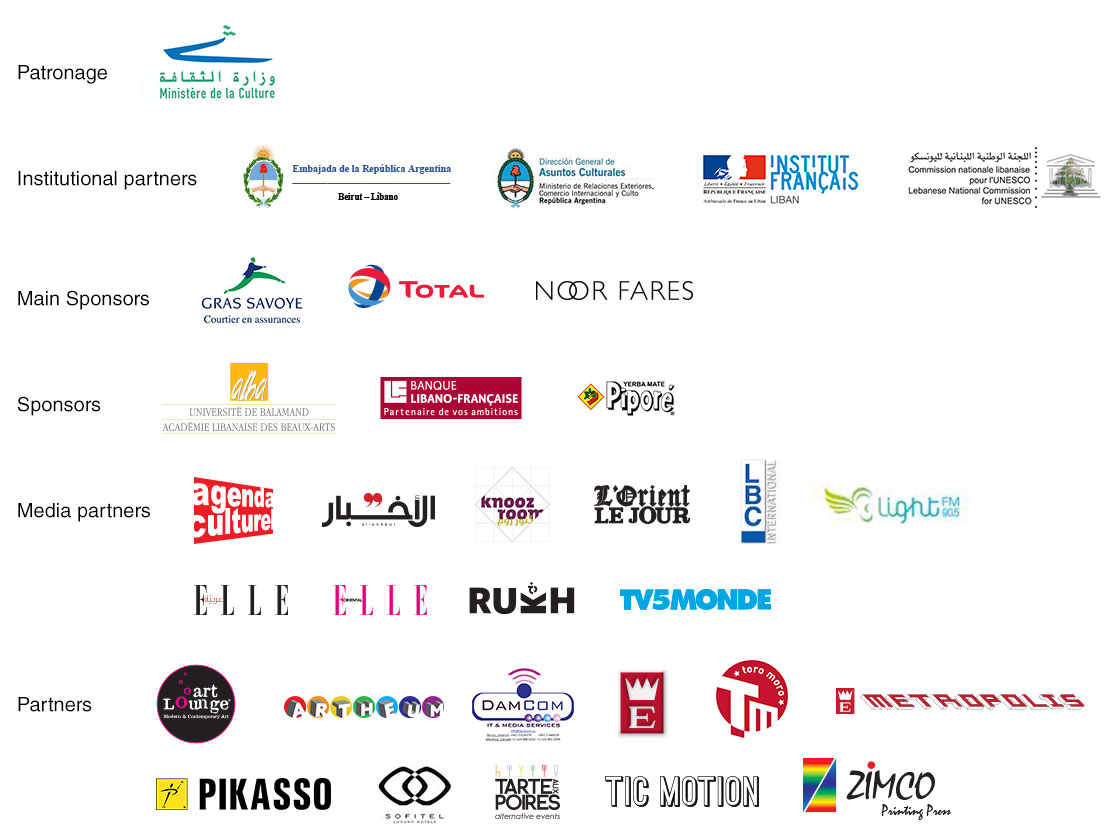
SPONSORS & PARTNERS LFF 2014


More Info

Beirut Souks - CinemaCity
FILM FESTIVAL
Gallery


© 2018 Copyright Lebanese Film Festival